|
People of a certain age insist that today's stars of stage, screen
and television can't hold a candle to show-business luminaries of
the past. A pronounced element of glamour, not to mention style, has
disappeared from the scene. Cher is hardly Garbo. Madonna couldn't
stand on the same stage with Merman.
People of a certain age insist that today's stars of stage,
screen and television can't hold a candle to show-business
luminaries of the past. A pronounced element of glamour, not to
mention style, has disappeared from the scene. Cher is hardly Garbo.
Madonna couldn't stand on the same stage with Merman. And so on. I
suspect that 30 or 40 years from now, today's young folk will be
saying the same about their current heroes and heroines. We tend to
protect and exalt our own icons.
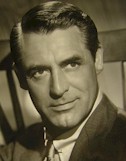
But today's nostalgia brigades have a point. There is no doubt
that certain popular figures from movies in the 1930's and 40's had
the kind of special presence that is sorely lacking in the
contemporary scene. You need go no further than the subject of an
hourlong album of photographs and film clips being broadcast tonight
at 10 on ABC: ''Cary Grant: A Celebration.'' Michael Caine, the
host, doesn't exaggerate when he calls Grant ''the idea, the very
ideal, of movie stardom.''
Grant, who died in November 1986, had a movie career that spanned
nearly 35 years, most of them at the very top. There are dark and
murky patches in his biography. Born and brought up in Bristol,
England, he saw his mother placed in a mental institution. He was
divorced four times before finding contentment with a fifth wife in
his final years. He arrived in New York in 1920 and stayed to work
in vaudeville and musical comedy. He didn't get to Hollywood until
11 years later, and then worked in 20 forgettable films before Mae
West trained her practiced eye on his possibilities.
In a series of screwball comedies that included ''His Girl
Friday'' and ''Bringing Up Baby'' he firmly established his
on-screen image of romantic elegance, even while doing somersaults
and pratfalls. Someone observes that he became to black-tie what
Fred Astaire was to white-tie. Ridiculously handsome, he developed
the shrewd trick of always seeming surprised and amused by the
effect he had on women. And the women in his screen life were
formidable: Katharine Hepburn, Rosalind Russell, Marlene Dietrich,
Ingrid Bergman, Deborah Kerr, Grace Kelly, Marilyn Monroe, Sophia
Loren and Audrey Hepburn. Talk about your good old days.
This television tribute - produced and directed by Mel Stuart and
written by Richard Schickel from his book about Grant - is filled to
bursting with scenes from Grant's films, from the earlier comedies
to the extraordinary series with Alfred Hitchcock (''Suspicion,''
''Notorious,'' ''To Catch a Thief,'' ''North by Northwest'') to some
of the more popular but minor successes later on. His biggest
box-office success was ''Operation Petticoat.'' After ''Walk, Don't
Run'' in 1966, he retired. He never received an Academy Award for
one of his performances. He was awarded an honorary Oscar in 1970
and a Kennedy Center Honor in 1981.
George Cukor, the director, once shared this insight: ''Cary
Crant was a handsome man who never acted as if he were.'' Whatever,
he was dashing, charming and wonderfully talented. He was also, in a
perhaps unsettling way, a complete creature of the movies. He once
said: ''I pretended to be someone I wanted to be, and finally I
became that person.'' The element of magic in his career is
undeniable.
The executive producers of ''Cary Crant: A Celebration'' are, in
keeping with past echoes, Jack Haley Jr. and David Niven Jr.
|