|
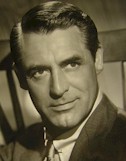
People have been talking about Cary Grant for
years.
He's used to it. Movie stars have been a
favorite topic of conversation and gossipy speculation for more than
70 years.
And ever since 1933, when Mae West offered that
memorable invitation to him _ ""Why don'cha come up
sometime, see me?'' _ Grant has been one of the biggest screen idols
of them all.
His dark good looks, clipped, faintly British
accent,
self-effacing charm and elegantly witty delivery
formed an inimitable, indelible image that will live forever in
Hollywood legend.
People naturally wondered if he really was the
carefree, sophisticated playboy he appeared to be on film, but they
could only guess. Off-screen, there were only occasional glimpses of
the private Grant, when one of his troubled marriages dissolved, or
when his experimentation with LSD made headlines.
When a celebrity of such lofty standing takes
pains to keep his personal life from public view, there's no way
around it. As the title of one of his 72 films says,
""People Will Talk.''
Now, just past his 80th birthday, Cary Grant has
decided to talk back.
He'll do it before a live audience at 7:30 p.m.
Thursday in the Kirkpatrick Fine Arts Auditorium on the Oklahoma
City University campus.
The program _ an open question-and-answer
session between the star and the audience _ is a benefit for the OCU
School of Music and Performing Arts, with tickets going for $75,
$100 and $200.
And why is he opening himself to such public
interrogation after all these years?
""I'm getting old and I don't care,''
Grant chuckled during a recent phone interview from his Beverly
Hills home.
Hearing that unmistakable voice, so instantly
recognizable and ingratiating, echoing from countless matinees of
the past, it was hard to picture an ""old'' Cary Grant.
""When you get to be my age,'' he
continued, ""it doesn't really matter what people do or
say. In fact, it never really did. No one has any control over how
anyone thinks or regards you.''
When he was told that many of his Oklahoma City
fans were happily anticipating his visit, Grant quipped,
""Oh, well, I'll dispel that illusion.''
The Thursday event, titled ""A
Conversation With Cary Grant,'' will open with a 10-minute montage
of scenes from some of his most memorable films. Then the man
himself will step onstage for a 60 to 90-minute chat with the crowd.
It will be only the sixth such speaking
engagement he has consented to do in the last two years.
""This question-and-answer format
works well for me. I enjoy it. I enjoy people and I trust they enjoy
me.''
Apparently they do. During his last public
appearance at Johns Hopkins University in Baltimore, a woman in the
audience stood up and sang to him. The song was ""You Made
Me Love You.''
""Oh yes, all sorts of things can
happen at these things,'' Grant laughed. ""That's the fun
of it.
""You see, I feel this way about it,
and I've tried to explain this to the audience. I don't always
remember to explain it because, frankly, when I walk out I haven't
the faintest idea what I'm going to do or what's going to happen.
""But I try to explain that I don't
wish to, nor am I capable of, imposing a speech upon the audience.
One's phraseology has to be exact and precise to get their point
over and I don't have any point I wish to get over.
""But I feel this way. If somebody
asks a question I know somebody in that audience is interested in
something, so I answer to that particular question. And I feel that
an audience is usually polite.''
However, Grant admits he's wide open to some
pretty personal questions.
""Oh, yeah, I get some pips! Oh, you
can make a detour around them, or answer them honestly. Like I say,
at my age I might just as well be honest.''
These public appearances may be the closest
thing to a Cary Grant autobiography his fans will ever get, he says,
because ""I'm too busy living my life to write about it.''
Grant says he also has little time to read what
other people have written about him, particularly the most recent
biography, Haunted Idol: The Story of the Real Cary Grant by
Geoffrey Wansell, a British writer and journalist.
The book attempts to trace Grant's life from his
birth in Bristol, England, (he was born Archibald Alec Leach, Jan.
18, 1904) through his teen-age years in a traveling vaudeville show,
his climb to stardom in Hollywood and his 34 years in films, to the
present.
The book paints Grant's childhood as an unhappy
one, describing his mother as smothering and obsessive; traits that
allegedly resulted in an uneasy mother-son relationship which
troubled him throughout his life.
Wansell also depicts Grant's four previous
marriages (actress Virginia Cherrill, heiress Barbara Hutton,
actresses Betsy Drake and Dyan Cannon) as unhappy, often stormy
affairs, and describes the actor himself as ""tense and
haunted'' and an ""obsessive perfectionist'' who was often
difficult to work with on a movie set _ a sharp contrast to the
relaxed, polished image Grant always created on screen.
Asked if the author's descriptions were
accurate, Grant said, ""I tell you, I have no idea. Ask
the people to whom he talked. As for my relationship with my
parents, I doubt if there's anyone who's living who knows anything
about that or cares.''
Wansell states in the book's prologue that Grant
declined to cooperate in the writing of it, but claims the actor did
meet with the writer for a brief interview back in 1981.
""That might be true, but I don't
remember the man,'' Grant said, obviously angry about the biography.
""He doesn't even know me.
""There's so much junk written about
people. I never understand why people write these things. They keep
stacks of information on you _ much of it misinformation _ and then
shove it into a book.
""It just is ridiculous that Joan
Crawford was beating a child with a coat hanger, or Errol Flynn was
a Nazi spy, or Tyrone Power a homosexual. Now that is just
thoroughly ridiculous.''
The biography focuses extensively on Grant's
experimentation with LSD in the late 1950s _ long before the
hallucinogenic substance became the favorite recreational drug of
the '60s counter-culture.
Grant readily confirmed that he had taken the
drug ""under supervision'' while undergoing an
experimental psychotherapy program.
""Why does one experiment with
anything, except that you hope to benefit from it.''
Grant points out that little was known about LSD
at the time, and that doctors were investigating its
""psychiatric benefits.'' Grant says he reaped those
benefits, and makes no apologies for his involvement with the drug.
Contrary to Wansell's portrait, Grant seemed _
at least in this brief phone conversation _ to be as affable and
happy as the characters he usually played on the screen. And his
memories of the business are pleasant ones _ especially his
association with ""a dear man named Hitchcock.''
In fact, it was the ""master of
suspense'' who persuaded Grant to come out of his first retirement
in 1954. It was a chance to work with ""a gifted young
actress'' named Grace Kelly as well as to collaborate once again
with Hitch, with whom he had already made three of his best films.
Grant recalled his first picture with Hitch,
""Suspicion,'' underwent a change of script during its
filming. In the story, Joan Fontaine is a wealthy woman married to a
man whom she loves, although she suspects him of plotting to murder
her for her money. Grant was brilliant as the suave yet mysterious
spouse who might or might not be a killer.
In the end we learn Joan's fears are unfounded.
But in the original climax, which was never filmed, Grant was indeed
plotting to do her in. In the last scene, Grant was to give her a
glass of poisoned milk. Just before she drank it, Fontaine would
hand him a sealed envelope, just an innocent letter she wanted him
to mail for her.
The film was to have faded out as we watched
Grant drop the letter into a mail box. The letter, unbeknownst to
the smug Grant, named him as his wife's killer. She had decided to
drink the poison rather than live with a man capable of taking her
life, but she had made sure he would pay for his deed.
""Oh I thought the original was a
marvelous ending,'' Grant laughed.
""It was a perfect Hitchcock ending.
But the studio said no, we can't have Cary Grant as a murderer.''
Looking back on his body of work, he admits
""there are some of them I wish I hadn't done.'' Two of
these were the period pieces ""The Howards of Virginia''
and ""The Pride and the Passion.'' He felt out of place in
these because, he says, ""I don't belong in costumes.''
He was always more at home in light,
contemporary comedy, which is where his fans preferred him as well.
And as for his retirement 18 years ago, still at
the height of his popularity, he has no regrets.
""I chose that particular time, first
and foremost, because I had made my greatest production _ I made a
daughter. I mean, I was involved in half the manufacturing, at
least.''
The co-producer of that blessed event, named
Jennifer, was his fourth wife, Dyan Cannon.
It was Grant's first child, and he was
determined to spend as much time with her as he possibly could. He
decided there wasn't enough time in his life to be a father and a
film actor. So he gave up the latter.
Now happily married to his fifth wife, Barbara
Harris, a former public relations specialist from Great Britain,
Grant says he's content with his home life and his business
involvements, which still keep him active.
""I enjoy what I'm doing now. I'd
never go back. I live in reality. Of course, making a film is
reality in itself, but what you're making is not real.
""You can never go back,'' he said.
""It's not possible. I could make another film but I'd be
playing a different man. People are used to me as a certain kind of
fellow and I can't make that film anymore.''
But, listening to him talk, one begins to think
Cary Grant, at age 80, is selling himself short.
|